Friday, 26 May 2017

Fox Enrichment

After a few weeks of bottle feeding and once they were eating solid food (meat and day old chicks), signed off by the vets and wormed, a few groups of our fox cubs were ready to be moved from their inside cubicles to our outside fox runs.  We took them out in skippers, put them in the run and opened the doors.  We watched for a while (from outside) and they appeared quite hesitant to start with but after a while they were sniffing around their new environment. They eventually found their den and disappeared.


Each run contains a concreted area (for hygiene purposes) and a small den where the cubs will spend much of their time initially.  We added tyres and pipes for enrichment and bark chippings to make it more representative of the wild.  Currently they are being fed twice a day but whenever time allows the team try to enrich the animals by enriching the pens and hiding / scattering food. Under Rob's guidance myself and fellow student Jenna drilling holes into logs in which we filled with donated dog food food.  Each run has a camera set onto motion sensor setting which allows us to check the foxes without interfering with them in anyway.  It is so important that we keep our wild animals wild which is reinforced to Jenna and I constantly by the team.

Jenna and I are looking forward to checking out the video tomorrow to see if all our hard work was worth it.  (Update: everything was gone the next day and it kept them busy for a while so all our hard work was worth it).

Catherine Smith
Student Placement

'If you would like to help RSPCA Stapeley Grange with a donation of just £3, simply text RSPCA2 to 70007' Texts cost £3 + standard network rate. 


Tuesday, 9 May 2017

A Purrfect Day

On my first day of my marketing placement here at the RSPCA Stapeley Grange Nantwich, I was asked to help out in the cattery. Straight away I was very happy and couldn't wait to get stuck in and meet all the cats.

Upon entering the cattery I noticed immediately that most came straight to their doors to meet you and enquire as to where their breakfast was.


When cleaning the rooms it was hard to not be distracted by them. Some cats were playful, running around with their ping pong balls and toys, others daring to escape from their rooms and visit their neighbours, some were quite shy, however most just wanted a good cuddle and a fuss.


I met one cat in particular who stood out to me when cleaning her room. Her name was Pearl and she was a tiny grey feline who was quite nervous at first but quickly began to play with me and hunt for her toy mice.

Once all the cat's room's had been cleaned and breakfasts devoured I would say it was a good job well done.

I am now looking forward to going into the animal hospital on Thursday to meet some of the wildlife and will be posting on the RSPCA Stapeley Grange Facebook and Twitter for the next few weeks. 

Rebecca Fletcher
Student Placement


'If you would like to help RSPCA Stapeley Grange with a donation of just £3, simply text RSPCA2 to 70007' Texts cost £3 + standard network rate. 

Tuesday, 14 March 2017

4 Blind Mice

During my time here I've come to realise that we really do care for pretty much all forms of wildlife, from the great to the small. Most recently our tiniest additions were a group of woodmice. When they arrived they were in a poor state, very cold and skinny, with their eyes still closed. 


To begin with the mice were syringe fed a milk and farleys mixture via cannulas as their mouths were so small. Luckily for staff they took to it well and after just four days were feeding for themselves, lapping farleys and milk from a bowl. This is very beneficial to the animals as it means staff can handle them much less often and they have a less stressful time in care before release. 


.

It's just a matter of time now before we are able to release them back to the wild, definitely the best part of the rehabilitation process

Jenna Haslam
Student Placement

'If you would like to help RSPCA Stapeley Grange with a donation of just £3simply text RSPCA2 to 70007‘ Texts cost £3 + standard network rate

Friday, 10 March 2017

Cubs galore!

It's still on the quiet side here at stapeley (although Spring is around the corner) but as a result of the stormy weather we've had recently we've encountered some touch and go situations, keeping staff on their toes! 

Many of you will have seen the news report on little Daffi but for those who haven't I've added a few very cute pictures. She was separated from her mother during storm Doris and was brought into care with us. To begin with she was given milk feeds every three hours but she quickly gained strength and moved on to a milk and trout mixture. 


She's now on just three feeds per day and doing very well. The staff are on the look out for a pairing for her. A further two otters were brought in later in the week. They were the same age as each other so it was assumed that they came from the same litter, so have been kept together. With these new arrivals, our otter total has been brought up to a huge 8 in our care!! 


I was also lucky enough to be in for the arrival of a tiny badger. The centre had previously cared for young badgers, the smallest weighing 350g but this baby was only 94g!! She was aged at only a few days old so after a few frantic calculations a feeding plan was drawn up and she was given milk formula every two hours. Luckily, she took to the syringe well and had a healthy appetite. 


After a few days with us she was transferred to Cuan Wildlife Rescue where she is now receiving around the clock care. It was sad to see her go as the staff had a real soft spot for her but she is doing well with our friends at Cuan now and will return when she is ready to join other cubs. 

Jenna Haslam
Student Placement

'If you would like to help RSPCA Stapeley Grange with a donation of just £3simply text RSPCA2 to 70007‘ Texts cost £3 + standard network rate


Wednesday, 21 December 2016

Swans a plenty at Stapeley

Throughout the year we see lots of swans and geese admitted to the wildlife hospital.  Many of the swans are brought in as juveniles, particularly at this time of year, and are reported by members of the public as being unable to stand and very weak.  When a bird is showing signs of weakness it may appear that it has problems with its legs but this is often not the case.

A case which I worked on this week was a good example of this.  The cygnet arrived on the 2nd  December, found by a member of the public, who was concerned the bird could not stand up and instead kept falling forwards.  The cygnet was extremely underweight when he arrived, weighing only 4.3 kg.  There was however a swelling on its wing joint.  On further investigation the x-ray showed that there was no serious damage; it was prescribed oral antibiotics, some pain relief and given plenty of food.


The team have kept a close eye on his weight over the past ten days and today he appeared healthy; was walking well and putting on weight.   He had his final check up this morning and the vets were happy to sign off his treatment and release him out onto one of our outdoor pools (pictured above) with all the other waterfowl, which is always nice to see.  The staff will continue to monitor his progress over the coming weeks until we are happy that he is strong enough to be released back to the wild.

Jenna Haslam
Student Placement

'If you would like to help RSPCA Stapeley Grange with a donation of just £3simply text RSPCA2 to 70007‘ Texts cost £3 + standard network rate


Saturday, 26 November 2016

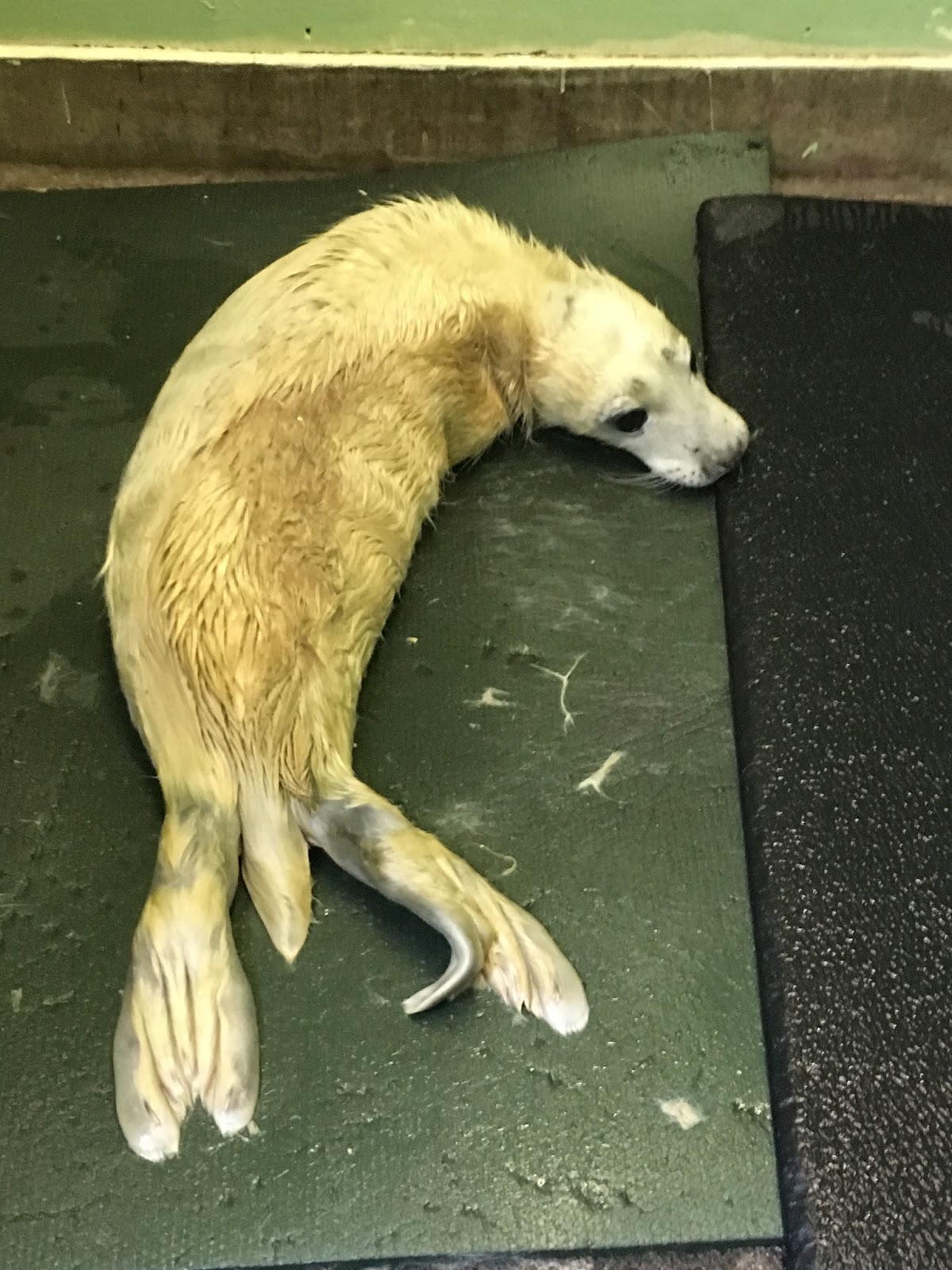
'Today gets the seal of approval' - Catherine Smith

After a morning of cleaning and feeding lots of hedgehogs I spent some time with wildlife assistants Michelle and Sophie in isolation. We were about to attempt to tube feed a seal...

The grey seal had been rescued in from Red Wharf bay in Anglesey on Wednesday (23rd Nov).  It had been monitored for 48 hours and no parents were seen during this time so help was needed. The orphaned seal is said to be about 2 weeks old; she weighed in at 15kg on admission. 


Trying to minimize stress as much as possible Michelle covered the seal with a towel and restrained it by kneeling over its back and pinning its head down (gently but safely), making sure her fingers were nowhere near its mouth! Then Sophie aided her with the syringe and tube whilst it was fed down its mouth and into its stomach. She also had the glamorous task of taking its temperature via the rear end. 


It was feisty as expected and made noises I'd never heard an animal make before. Staff here receive lots of training with seals as although they look cute they can give you a nasty bite, apparently. The seal is tube fed five times a day and is currently being fed a mixture of lectade which is a re-hydration therapy with aqua-vitamins and fish soup which is blended mackerel. 

This seal is being transported to RSPCA East Winch Wildlife Centre shortly; they specialize in the rehabilitation of seals and offer more facilities for this. I am confident it will grow and make a full recovery and I am eager to keep up with its story.

Catherine Smith
Student Placement

'If you would like to help RSPCA Stapeley Grange with a donation of just £3simply text RSPCA2 to 70007‘ Texts cost £3 + standard network rate

Wednesday, 16 November 2016

Fox Release

A couple of weeks ago I was lucky enough to be asked to help on one of the last fox releases for this year. The site was quite local at a commercial quarry. Myself, Rob (Senior Wildlife Assistant) and Sophie (Wildlife Assistant) loaded all the kit into the car and trailer and eventually managed to coax all five juveniles into a box for transporting. I drew the short straw and had to sit in the back nearest to the foxes which if you've ever smelt a fox before then you'll probably understand and feel my pain. 


To our delight, we were joined by a couple of members of staff on site. The RSPCA most of their orphaned mammals species through a method of release known as a 'soft release' which means they are first transferred to large cage at the release site and then support fed and watered over a period of three weeks after being released, with the amount of support feed decreased over time to help bridge the transition between captivity and living in the wild. 

The cage is made up of eight wire panels, so the first step was to stride out a suitable area and then dig out a trench to drop the panels into, before then bolting then together. Setting the cage into a trench helped to prevent the foxes from digging out, in theory! Once built the box with the foxes in was placed inside.  Branches and leaves were also put inside and on top of the cage to make it more natural, along with some food and a bucket of water.

After everything was finished it was down to Rob to open the box and to make a quick escape. On this release, we were lucky enough to see one very brave fox emerge and have a quick feed before we had to leave. The foxes will be caged for one week before being released and then support fed for the further three weeks.

Jenna Haslam
Student Placement

'If you would like to help RSPCA Stapeley Grange with a donation of just £3simply text RSPCA2 to 70007‘ Texts cost £3 + standard network rate